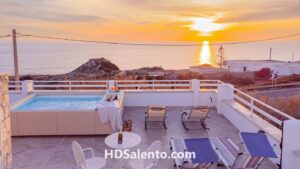
S, Gregorio in Salento is the marina of Patù, a small jewel a few kilometres from Santa Maria di Leuca on the Ionian coast of Salento. Formerly the port of ancient Vereto, the ancient moorings can still be seen today. With an uncontaminated sea, it is easy to feel good in the water, nothing to envy to faraway exotic places.

Marina of San Gregorio, Apulia
It is one of the few places where one can admire sunrises and sunsets in all their poetry crossed by the entire palette of colours, a miracle that only the south of Salento can provide. It has a small beach where you can sunbathe near the Moro bar, a landmark of the marina.

Moving a few hundred metres southwards, we find the Scogli Piatti, sea rock formations polished by the sea where, in addition to bathing, one can sunbathe in privacy given the difficulty of access. There is no shortage of refreshment points scattered here and there throughout the area.
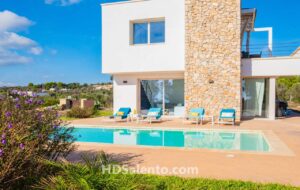
For those wishing to stay there, there are many holiday home solutions at very reasonable prices by contacting local agencies. With a little imagination, on nights when the moon is full, one can still hear the songs of Greek and Phoenician sailors, which, as still happens today when thinking of a loved one, brings a furtive tear to the eye.
The history of Patù
A town in the Lower Salento a few kilometres from Santa Maria di Leuca, Patù owes its name to the Greek word Pathos, pain in memory of the destruction of the town of Vereto, an important Messapian centre destroyed by the Saracens in the ninth century AD. Patù was then built nearby using what was left of the ancient Vereto.
Religious monuments in Patù
Mother Church of St Michael Archangel built in 1564. Under the rose window of the entrance portal, there is an inscription in Latin (TEMIBILIS EST LOCUS ISTE) considered to be of esoteric origin.
- Church of St John the Baptist built between the 10th and 11th centuries with pieces of the ancient city of Vereto. It was erected after the battle between Christians and Saracens on July 24th 877 AD. Today, St John the Baptist is still celebrated on June 24th.
- Church of Our Lady of Vereto, startedin the 17th century. It stands on the highest point of the hill and corresponds to the Acropolis of the town of Vereto.
Patù Archaeological Site
Vereto
An ancient Messapian city located on the hill adjacent to the town of Patù, it was an important centre of trade with both Greece and Magna Graecia, through its port in the bay of San Gregorio, where its remains can still be admired today.
Cento Pietre (One Hundred Stones)
The Cento Pietre is an ancient funerary monument declared a second-class national monument by the Italian State. It was built in the ninth century AD as a sepulchral mausoleum in honour of Knight Geminianus slaughtered by the Saracens before the battle of June 24th 877. Rectangular in shape, it was built with one hundred limestone slabs taken from the ruins of Vereto.
Customs and Traditions of Patù
Here in San Gregorio Salento, time really does seem to have stood still; the inhabitants, almost all of rural origin, have handed down values and traditions over the years that have maintained their uniqueness. A small treasure chest of ancient knowledge that is reluctant to be contaminated.
All this makes it a true and genuine place. The cuisine is the typical one of Salento with products that this rich land offers. For travellers wishing to taste its secrets, we mention La Rua De Li Travaj, a historic trattoria where the name takes us back to the various dominations of this part of Italy.
An event worth remembering is the infiorata; a unique event where the entire town is involved in carpeting the streets with real paintings made of flowers with temptations to taste. The event coincides with the Corpus Domini festival in June.
https://www.hdsalento.com/wp-content/uploads/2021/11/20210130_114952-rotated.jpg