
Parabita is a gem set in the heart of Salento, authentic, genuine and guardian of an important history. Located in the province of Lecce, this charming town is known for its historical-cultural heritage and its extraordinary beauty. With its charm and intimacy, Parabita immediately captures the hearts of anyone who sets foot there. In this articleyou will discover its history, how to get there, what to see and where to eat.
Where is Parabita located?
Parabita Lecce is located in the Salento hinterland, just east of Gallipoli. The city rises on the northern hills of the Salento greenhouses, at an altitude of 83 meters above sea level. The inhabited center develops in the south-western part of the Serra di Sant’Eleuterio, an important morphological formation in the area, thanks to its maximum altitude of 193 meters above sea level.
The village of Parabita borders the municipalities of Tuglie and Neviano in north, Collepasso to the east, Matino to the south and Alezio to the west. This geographical position makes Parabita an interesting destination for those who wish to explore the natural and cultural beauties of Salento.
How to reach Parabita?
To reach Parabita we recommend that you rent a car so you will have the to move as best as possible and fully discover Salento. However, if you have no way to get around by car, here’s how to get to Parabita:
- By plane: you can take aflight to Brindisi Airport or to Bari Airport. From there you can use the bus or train to get to Lecce and from here take a bus to reach Parabita.</span >
- By train: you canget to Lecce by train and from here take the local buses that connect the city to Parabita.
- By car: the main roads to reach Parabita are the SS101 and the SP 371 or the SS16 Adriatica.< /span>
- By bus: There are no direct buses connecting the big cities to Parabita, but once you arrive in Lecce you can reach Gallipoli and from here take Salento line 102 by bus from Gallipoli.
What does Parabita mean?
The name “parabita” has uncertain origins and several theories about its meaning. Some hypotheses suggest a Greek origin with the meaning of “around the walls” or “soldier supporting the cavalry”. Another theory links the name to a mysterious Messapian city of Bavota, but this idea has been rejected by scholars. Over the centuries, the name of Parabita has undergone several variations, until reaching its current form. These evolutions reflect the history and language of the region.

The Story of Parabita
The territory of Parabita, like all the territories of lower Salento, has been inhabited since ancient times. It is believed that humans of the Homo Neanderthalensis species were present in this area around 80,000 years ago, as demonstrated by the discovery of stones in the surrounding caves. During the twentieth century, fragments of bones and two small sculptures dating back to 12,000-14,000 years ago were also found, depicting pregnant women, belonging to the Homo Sapiens Sapiens species.
The idea that Parabita descends from an ancient city called Bavota is disputed by scholars and has no historical basis. The most reliable source,Claudio Tolomeo, never mentions Bavota in his Geographia. It is possible that the legend of the city was born from a transcription error of the name of Vaste (Poggiardo), or that there was a Roman villa-storage room called Bavota near Parabita. There is no historical evidence, documents or archaeological finds to suggest the existence of an ancient city or major settlement near Parabita. A descent from Alezio is much more likely, also supported by linguistic similarities in the local dialect.
The city of Parabita was built during the Norman period, following the typical urban layout of the time and equipped with defensive walls and four access gates. During feudalism, several families held control of the fiefdom, including the Gentile da Nardò, the De Tillio, the Aldimari, the Sanseverino and the D’Aspert families. In the 15th century, the farmhouse passed to the Orsini del Balzo family from Ugento, who held it for over a century. In 1484, Parabita was invaded by the Venetians during the occupation of Gallipoli. In the 16th century, due to the war between the French and the Spanish, the Del Balzos lost their rights to the farmhouse, which passed to the Royal Tax Authority and was subsequently purchased by Pirro Branai Castriota. The Granai family managed the fiefdom until it was seized by the tax authorities for debts in 1678 and sold at auction in 1689 to Duke Domenico Ferrari. After the death of the duke, the fief passed to his nephew Giuseppe and his descendants, who were the last feudal lords of Parabita before the abolition of feudalism in 1806-1808.
What to see in Parabita?
If you want to visit Parabita know that there are things to see, despite the Its modest dimensions, there are many. Here are the main points of interest:
- Church of San Giovanni Battista: A historic church that dates back to the 13th century and has undergone several expansions over the years centuries, with a three-nave plan and altars dating from the 15th to the 18th century. It preserves the remains of St. Vincent the Martyr from the catacombs of Commodilla in Rome.

- Basilica sanctuary of the Madonna della Coltura: A basilica built between 1913 and 1942, it stands on a previous church from the 17th century and contains a Byzantine fresco from the 11th-12th century depicting the Virgin and Child.
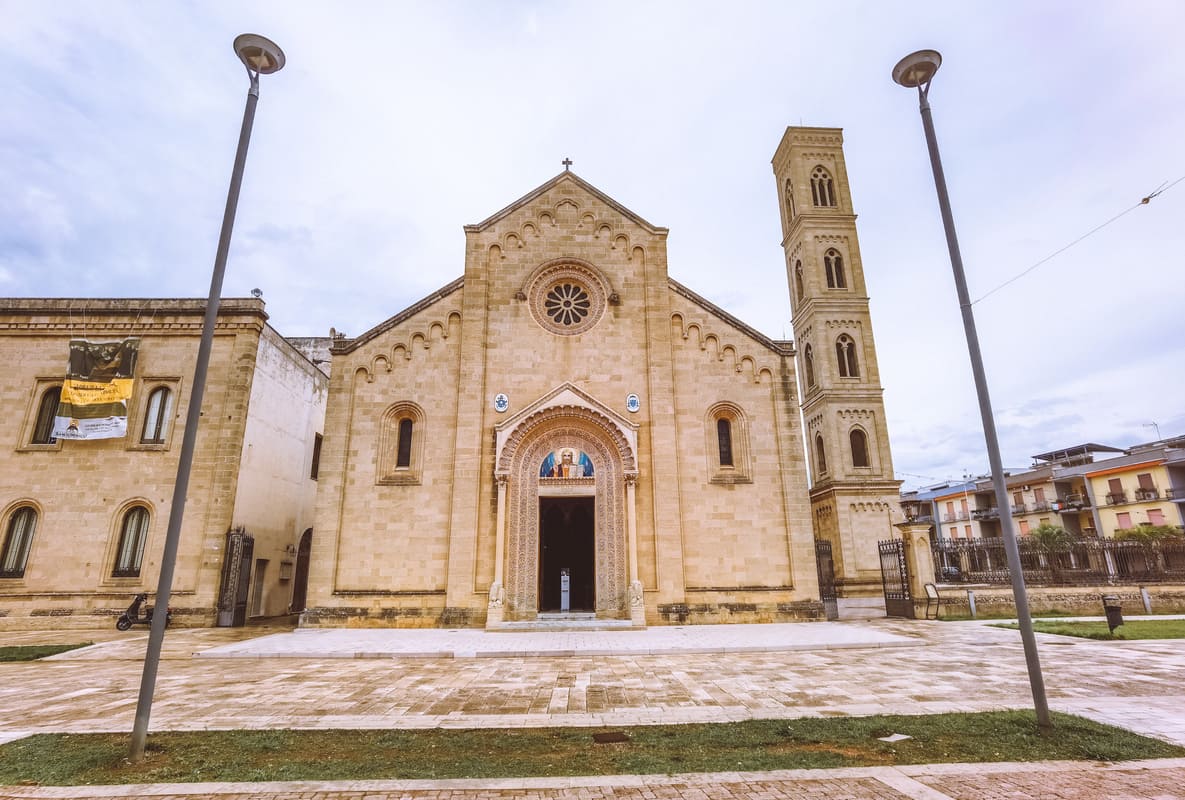

- Church of the Immaculate Conception: A sixteenth-century church, rebuilt in the seventeenth century, with a sober and linear façade. Inside it features sumptuous baroque stuccoes and frescoes depicting scenes from the life of the Virgin.
- Church of Souls: Built in the first decades of the eighteenth century, it has a simple facade and a single nave interior with frescoes and a main altar in Baroque style.
- Church of the Crucifix and Convent: A convent complex founded in 1731, with a church characterized by a sober façade and a single nave interior with a main altar in Lecce stone.

- Convent of Santa Maria dell’Umiltà: Founded in 1405, it was expropriated and underwent modifications over the years centuries, still retains some decorative elements, including a sixteenth-century fresco.
- Crypts: Parabita hosts two Byzantine crypts, theurban crypt of Santa Marina< /b> and the rock crypt of Cirlicì.</span >
- Monumental cemetery of Parabita: Designed in 1967, it is a cemetery with a plant symbolizing the explosion of a capital Corinthian.
- Historic buildings: Palazzo d’Alfonso or Castriota, Palazzo dei Veneziani, Palazzo Ferrari, Palazzo Vinci, Palazzo Lopez Y Royo, Ramis Palace.

- Angevin Parabita Castle: A fortress dating back to the 14th century with characteristic architecture and an important renovation in 15th century.

- Archaeological sites: Underground crushers, Grotta delle Veneri, a cave that takes its name from two female horse bone figurines , the Venuses, dating back to about 20,000 years ago.
The Venuses of Parabita
The Venuses of Parabita, kept in the National Archaeological MuseumTaranto , are an important point of interest of Parabita. These are two bone sculptures that depict female images in an upright position. The largest, measuring approximately 9 cm high and 2.1 cm wide, is carved from the bone material of a large herbivore, perhaps a Bos primigenius or an Equus caballus. The face is covered by a veil or mask, while the arms are placed under the belly, suggesting that it represents a pregnant woman.
The smaller sculpture, approximately 6.1 cm high and 1.5 cm wide, has a simpler appearance and appears to have been used as an object with carved decoration.
Both sculptures, thanks to their stylistic traits and characteristics, provide important clues about the culture and artistic techniques of the ancient populations who created them, and are objects of great interest for scholars scholars of archeology and prehistoric art.
Where to eat in Parabita?
If you are looking for delicious restaurants in Parabita we have some recommendations for you. Here’s where to eat:
- Cotto & Mangiato
- Antiche Tradizioni Ristorante Braceria
- La Madre
- Le Veneri
- LI Rrusti


