
Let’s start by saying that Otranto it is one of the most beautiful cities in Italy; it lies on the Adriatic coast 40 km from Santa Maria di Leuca, boasting the record for being the easternmost town in Italy.
The Romans called it “Hidruntum“, because of a stream flowing through the valley, later becoming Otranto. It was inhabited in the Neolithic period, then populated by the Messapi, the Greeks and finally, conquered by the Romans.

Its geographical position led it to become the most important port in Italy, creating a bridge between East and West. Highly coveted therefore, it was a Byzantine and Gothic, Norman, Swabian, Angevin and Aragonese centre.
Chronicles of the time tell of the blessing of 12,000 men for one of the many Crusades, it was 1095. An inauspicious date was August 11th 1480 when Muhammad II’s Turks razed it to the ground, as if that were not enough, on August 14th 800 prisoners were beheaded for not wanting to embrace the Muslim religion.
They are still venerated today as the Martyrs of Otranto. Few, however, remember the destruction of the Monastery of San Nicola di Casole just south of Otranto, which contained the largest library in what was then considered the West, and the Basilian Monks had established the first college in history, hosting students from all over Europe…

In the 17th century, tired of the repeated attacks, the inhabitants abandoned the city for safer places, contributing to its decline. The 1700s saw it recover with the help of wealthy Salento families who invested in the city.
In the late 19th century, the reclamation of the surrounding lands that had become marshy due to abandonment was carried out, so new lands emerged on which to cultivate, starting a discrete agriculture and reviving the town.
These vicissitudes brought it with hard work and dedication to what we can admire today sitting comfortably in front of the now safe harbour sipping a lemonade!
What to see in Otranto
Those who choose Otranto as a tourist destination want the best. This can only be had from a city that has more than 2000 years of history, a strategic location, and a Californian climate. Let us briefly try to understand what this beautiful city has to offer.
Otranto Castle
Otranto Castle, or Aragonese Castle, takes its name from the person who had it built; Alfonso d’Aragona started it in 1485 and finished it in 1498, it has a deep moat and like any self-respecting castle it has a drawbridge, the coat of arms of Charles V stands out on the main door.
Now that men no longer challenge each other in regular combat, the castle only hosts cultural events aimed at world peace.

Otranto Cathedral
The Cathedral is dedicated to Santa Maria Annunziata, it was built in the 12th century and stands on the remains of a Messapic village. Over the years and countless sacks, it was remodelled several times, changing its appearance. Inside, we can admire the stupendous mosaic; the largest in Europe and the remains of the Eight Hundred Martyrs.

Mosaic of Otranto
The splendid Cathedral of Santa Maria Annunziata houses an incredible mosaic begun in 1163 and finished in 1165 by Pantaleone, a Basilian monk.
Besides being huge, it touches on the highlights of the sacred scriptures with a beautiful tree of life in the centre. For those interested in mosaic art, however, the mosaic features many anomalies and figures that were inconceivable at the time.

Even today scholars from all over the world try to decipher its secrets, without coming to any conclusion. Perhaps Pantaleone wanted to leave a memory of himself not for the beauty of the work, but for the simplicity of the chaos.
The Grotta dei Cervi (Deer Cave)
The Grotta dei Cervi is a cave you should be aware of, but unfortunately it cannot be seen. It is a natural coastal cave situated in the bay of Porto Badisco, not far from Otranto, it was discovered in 1970. Its importance is such that it was decided to keep it closed.
Inside, there are beautiful drawings depicting deer hunting scenes made of ochre and bat guano dating back to the Neolithic period.
Bauxite lake
This is an artificial lake where the mineral bauxite was once mined to form aluminium. After 1970 it was abandoned due to very high costs, so this huge red hole was left, which a vein filled with water, becoming a small marshy area.

City of Otranto
Nowadays it is a quiet and sunny southern town, and like all places that have an ancient history, it has an old part of historical interest, and a recent part of expansion, devoted to tourism and amenities.
Being by the sea, it has an important port that is beautiful to see while enjoying a pistachio ice cream, or to slip into the old town made up of narrow streets while waiting for the ferocious Saladin to come out, or to go shopping in Via Napoleone among designer clothes and unique pieces of Salento craftsmanship such as the Salento shoes, leather sandals that are strictly handmade and therefore indestructible.
Port of Otranto
The port has always been a place of the utmost respect, because it was from there that ships departed to defend the Salento coast against Turkish raids.
Today it is a large tourist port with a large fleet of motorboats belonging to the Guardia di Finanza to counter the flow of illegal immigrants and make the waters safer; it has a small fleet of fishing boats, one of the country’s first resources, catch which we will then go and taste as a speciality in one of the many places where you can eat well.
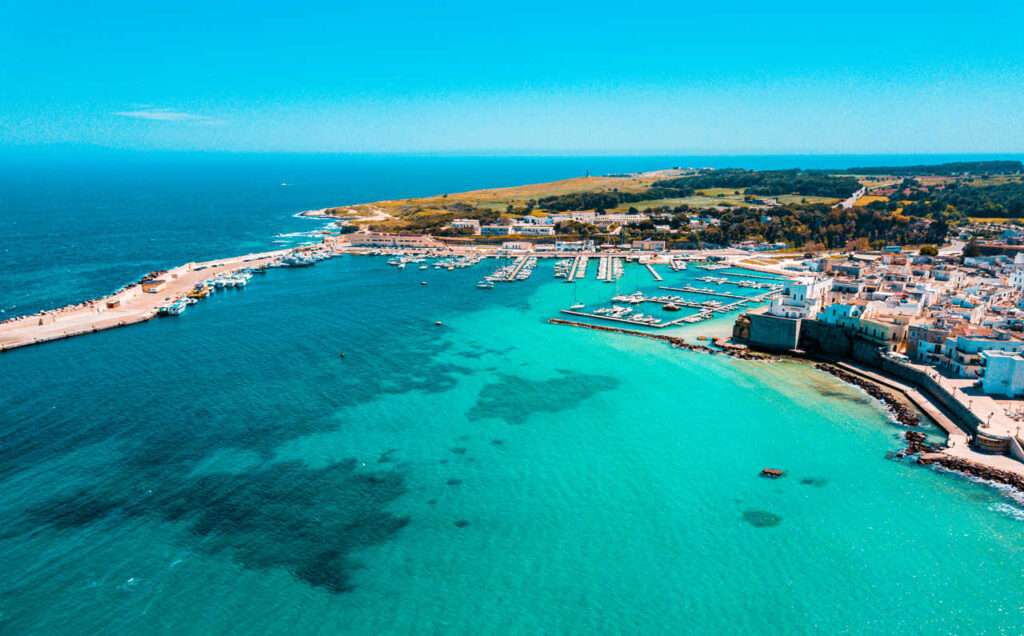
Sea in Otranto
It stretches from the Alimini lakes in the north to the bay of Porto Badisco in the south. It is a beautiful stretch of beaches, including those within the city, where the water is always sublime.
Along this stretch, one discovers small coves characterised by some very beautiful caves, one of which is Grotta Monaca, a beautiful beach with an adjoining cave whose name comes from the sporadic presence of seals.
Alimini beach
Heading back north, we find the beaches of the Alimini lakes and the two lakes of the same name formed by freshwater springs, the first is called Fontanelle or Piccolo and feeds its larger brother. Clearly, the presence of fresh water causes the Mediterranean scrub to explode, making the beach less monotonous.
This part of the coast is full of resorts and holiday villages, including the Club Mediterranee.
Baia dei Turchi
Near the area of the Alimini lakes, we find an enchanting place, the Baia dei Turchi, so called because it was on this very beach that the Turks landed in 1480, destroying the city. Fortunately, today it is only a memory. The beach has remained intact to enjoy all its natural beauty, a low cliff on one side, invites you to a beach of the finest white sand with a sea so blue that the eye can hardly recognise it.
Porto Badisco
This is a hamlet of Otranto and also overlooks the sea. Many academics indicate it as the probable landing place of Aeneas, but let us leave legend to deal with reality: the Grotta dei Cervi (Deer Cave), envied by the whole world, both for the period in which it was inhabited, the Neolithic, but above all for the beauty of the drawings depicting deer.

Otranto Park Leuca
Since October 2006, the Idruntino territory has been part of the Costa Otranto – Santa Maria di Leuca e Bosco di Tricase Regional Natural Park, desired by the Apulia Region with the aim of safeguarding the Salento Adriatic coast rich in important sites and rare animal and plant species.
Where to eat in Otranto
This time we want to make a list where you can spend little money:
- Postofisso
- Skate Baguetteria
- Merola Patisserie
- Gelateria Cavour
- La Trattoria
- Saporì
- Birrificio Terra D’Otranto Craft
- Lu Tata Nzinu
- Ristorante in Agriturismo Terra Rossa
- Blu Bar Bistrot
There are, of course, a hundred other places to go and eat and we couldn’t mention them all, let’s just say that everywhere uou will eat like God and we dare you to contradict us.
Curiosities about Otranto
As a witness to peace, it is one of Unesco’s World Heritage Sites, and one of the most famous Gothic novels written by Horace Walpole in 1764 was set in its castle.
The Alba dei Popoli is another cultural event organised by the municipality and consists of promoting events to strengthen the figure of this splendid city: the most important appointment, is on New Year’s Eve, at Punta Palascia, the most easterly point in Italy, where the two seas, the Adriatic and the Ionian, embrace, the first ray of sun from the East illuminates Otranto, being the first to witness the dawn of the new year.

Crossing this imaginary bridge we can feel closer to the people of the Mediterranean.
The event was born in 1999 with the presence of many italian and international artists who have always been sensitive to world peace:
- Goran Bregovic
- Franco Battiato
- Eugenio e Edoardo Bennato
- Nicola Piovani
- Lou Red
- Pino Daniele
- Mario Biondi
- Roy Paci
- Avion Travel
- Giuliano Palma
- Nina Zilli
- Stadio
- Roberto Vecchioni
- Max Gazzè
- Alex Britti
- Luca Carboni
- Fiorella Mannoia
- Vinicio Capossela
- Antonello Venditti
and directors such as:
- Ferzan Ozpetek
- Elliir Kusturica
- Manuel Pradal
This makes us realise once again the importance of peace linked to the culture of the people. The pastel colours and the beauty of the beaches contribute to making Otranto one of the most beautiful villages in Italy!
https://www.hdsalento.com/wp-content/uploads/2020/02/Foto-Porto-Otranto.jpg


